Brass pipe nipplesIntroductionBrass pipe nipples are short sections of brass tubing with male t...
How to Prevent Material Degradation in the Hot Runner System?
2025-08-06
The Importance of Hot Runner Systems for the Plastics Industry
A hot runner system is a critical technology in modern plastic injection molding, significantly improving production efficiency, part quality, and cost-effectiveness. Its importance in the plastics industry can be understood from the following key aspects:
Enhanced Product Quality
Hot runner systems maintain precise and stable melt temperature during injection molding. This ensures consistent material flow and cavity filling, which reduces defects such as sink marks, weld lines, or incomplete filling . High-quality parts with superior surface finish and dimensional accuracy can be produced efficiently.
Reduced Material Waste
Unlike cold runner systems, hot runner systems eliminate the need for runners that must be trimmed and discarded after molding. This leads to minimal material waste, improved raw material utilization, and significant cost savings, especially for high-volume production or expensive resins.
Increased Production Efficiency
By keeping the plastic in a molten state within heated channels, hot runner systems eliminate the cooling and re-melting steps required in cold runners. This reduces cycle times and allows for faster and more continuous production, boosting manufacturing throughput.
Improved Process Control
Modern hot runner systems feature precision temperature control and advanced monitoring. This helps maintain uniform melt conditions across all cavities, prevents material degradation, and ensures optimal process stability-critical for complex or multi-cavity molds.
Design Flexibility
Hot runner technology supports more advanced and compact mold designs. It allows direct gating into part cavities, which is ideal for complex geometries or multi-cavity tools. This flexibility reduces secondary operations and supports automation in molding lines.
Energy Savings and Sustainability
By eliminating regrind processes and reducing material waste, hot runner systems contribute to
more sustainable manufacturing. The lower energy consumption per molded part aligns with the
plastics industry’s push for eco-friendly production.
How to Prevent Material Degradation in the Hot Runner System?
Material degradation is one of the most common issues in plastic injection molding with hot runner systems. It not only affects part quality but also increases production costs due to scrap and rework. Understanding the causes and implementing preventive measures is essential for efficient and defect-free molding.
Precise temperature control of the molten plastic effectively prevents material degradation. Excessive temperatures can cause plastic decomposition, so it is essential to maintain the temperature within the proper range.
Flow channel design should ensure uniform filling of the part cavities to avoid localized overheating or overcooling, thereby reducing material residence time and uneven heating in the channels.
Proper hot nozzle specifications and sizes ensure smooth melt flow and complete cavity filling, minimizing material degradation caused by poor flow.
Optimized gate structure and size help achieve complete cavity filling. Needle-valve gates can close promptly to reduce stringing and shorten the injection molding cycle.
Flow channel design should avoid dead spots and gaps to minimize material stagnation and degradation in these areas.
Optimizing the design to reduce pressure loss lowers energy consumption during injection molding and reduces the risk of material degradation.
Appropriate clamping force helps prevent excessive compression of the material by the mold, thereby reducing the likelihood of degradation.
Control holding time within a reasonable range to avoid excessive compression and degradation caused by prolonged holding pressure.
Smart Choice: Topower TP01
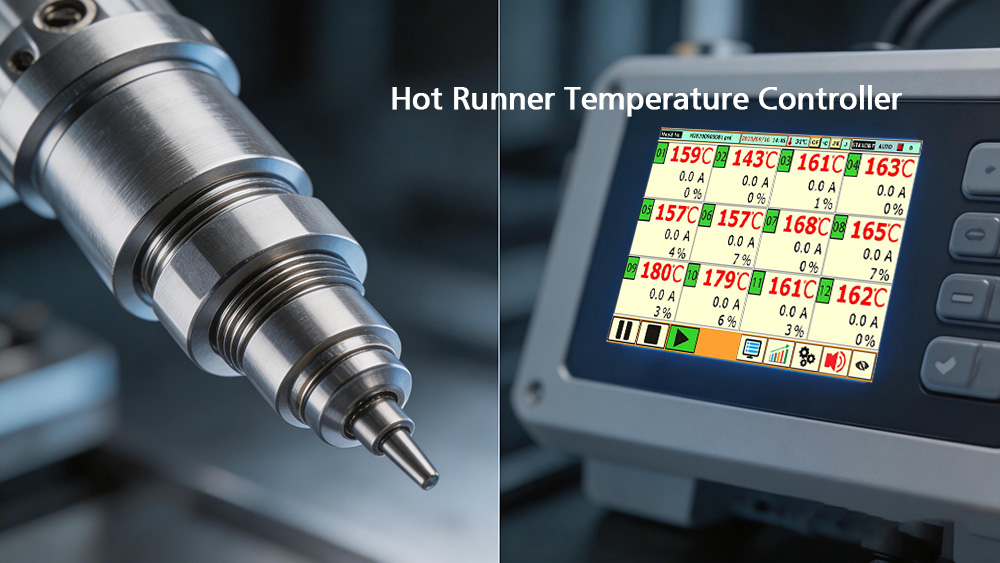
Topower TP01 hot runner temperature controller uses a soft-start function and proportional output ramp-up, ensuring gentle, even heating. This protects both material properties and tooling.
From startup to shutdown, TP01 protects your materials and margins.