Brass pipe nipplesIntroductionBrass pipe nipples are short sections of brass tubing with male t...
Temperature Control and Energy Efficiency in Modern Manufacturing: From Thermocouples to Hot Runner Systems
2025-08-26
Introduction
In today’s manufacturing industry, precise temperature control is fundamental not only for ensuring product quality but also for reducing energy consumption and production costs. Two critical elements in this process are thermocouples, which provide accurate temperature measurement, and hot runner systems, whose energy efficiency directly impacts operational expenses and sustainability. This article provides an overview of how thermocouples work, highlights commonly used types, and explores key considerations in designing energy-efficient hot runner systems.
How Does a Thermocouple Work?
A thermocouple is a widely used sensor for temperature measurement. Its principle is based on the thermoelectric effect, specifically the Seebeck effect. When two different metals form a closed circuit and the junctions are at different temperatures, a voltage proportional to the temperature difference is generated.
Generation of thermoelectric effect:
Free electrons in metals move toward the cooler junction, creating a measurable voltage.
The magnitude of this voltage is directly proportional to the temperature difference.
Voltage measurement and conversion:
By measuring this voltage and referencing known temperature-voltage relationships, precise temperature values can be calculated.
Because of their simple structure, rapid response, and high resistance to extreme conditions, thermocouples are indispensable tools in industrial temperature monitoring and control.
Common Types of Thermocouples
Type K Thermocouple
Composition: Nickel-chromium and nickel-aluminum alloys
Temperature range: –200°C to +1372°C
Advantages:
Excellent stability and accuracy
Fast response to dynamic temperature changes
Cost-effective and versatile
Applications: Widely used in metallurgy, chemical processing, heating equipment, electronics manufacturing, and plastics due to its wide temperature tolerance.
Type J Thermocouple
Composition: Iron and copper-nickel alloy
Temperature range: –40°C to +750°C
Advantages:
High stability at low temperatures
Economical option for cost-sensitive applications
Fast response for precise monitoring
Applications: Common in food processing, pharmaceuticals, refrigeration, and air-conditioning — especially effective for low-temperature testing and freezing equipment.
Designing Energy-Efficient Hot Runner Systems
In modern injection molding, hot runner systems play a crucial role in energy efficiency. A well-designed system not only lowers electricity bills but also minimizes material waste, ensuring both economic and environmental benefits. Below are the key design considerations:
Precision Temperature Control
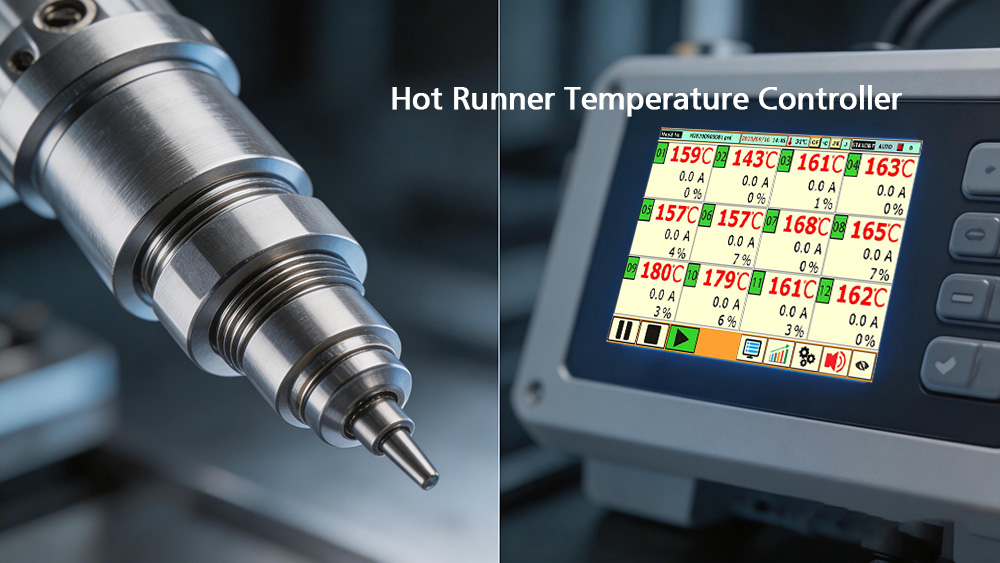
Inaccurate control leads to overheating and wasted energy. High-precision digital controllers can respond quickly to real-time fluctuations, avoiding unnecessary power consumption.
Optimized Heating Element Layout
Improper heating layouts cause uneven temperatures. Using simulation tools to design heating distribution ensures uniform heating across all runner channels.
High-Efficiency Heating Elements
Advanced heating elements such as quartz tubes, ceramic heaters, or self-regulating heating belts reduce heating time, maintain stability, and increase energy utilization.
Intelligent Temperature Management
Smart control systems monitor temperatures in real time, automatically adjusting heating strategies according to production needs. This minimizes over-heating or cooling and adapts to cycle loads.
Material Selection
Using materials with high thermal conductivity reduces heat loss inside runners, while insulating materials help prevent energy leakage into the external environment.
Precise Cooling Control
Efficient cooling is as important as heating. Overcooling or slow cooling wastes energy. By regulating cooling time and temperature with precision, energy use during this stage is minimized.
Heat Recovery Systems
Modern hot runner systems can recycle waste heat to preheat other areas or processes, reducing overall energy demand and operational costs.
Why Energy Efficiency Matters
Energy-efficient hot runner design brings multiple advantages:
Reduced operational costs: Lower electricity bills through optimized energy usage.
Improved product quality: Stable and precise temperatures ensure consistent molding results.
Environmental compliance: Lower energy waste supports sustainability goals and regulatory requirements.
Competitive advantage: Companies adopting efficient systems gain a long-term edge in productivity and market competitiveness.
Conclusion
From thermocouples that measure temperature with precision to hot runner systems optimized for energy efficiency, temperature management technologies form the backbone of modern manufacturing. By combining accurate sensing with intelligent system design, manufacturers can significantly cut costs, enhance product quality, and achieve sustainable growth.
The future of manufacturing lies in smarter, more efficient thermal management, where innovation and sustainability are inextricably linked.