
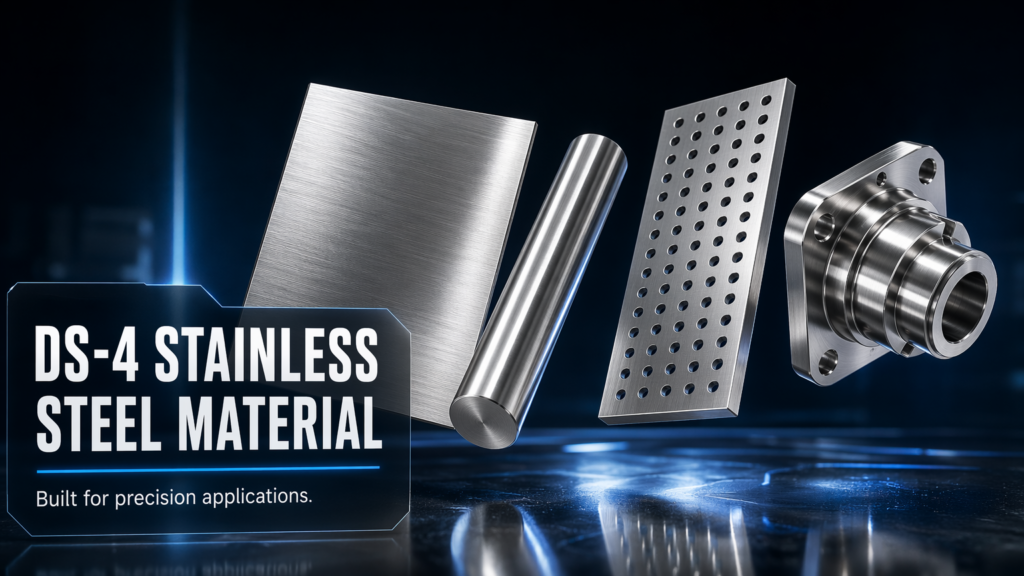
DS-4 Stainless Steel Material: What Is It and Why It Matters
DS-4 stainless steel material (also called 17-4 PH, UNS S17400) is a precipitation-hardening grade that combines high strength with good corrosion resistance. Engineers and mold makers turn to DS-4 stainless steel material when they need a material that handles heavy mechanical loads and still resists rust and wear in demanding production environments. Unlike conventional stainless steels that rely solely on carbon content for hardness, 17-4 PH gains its strength through a low-temperature aging process. Copper-rich particles precipitate out of the matrix during this treatment, boosting tensile strength up to 1,310 MPa without the distortion problems typical of quench-hardened steels.
The name says it all. "17" stands for roughly 17% chromium. "4" represents about 4% nickel. "PH" means precipitation hardening — the heat treatment cycle that makes this alloy stand out. Engineers and mold makers specify 17-4 PH when they need a material that can handle high mechanical loads and still resist rust, chemicals, and wear in service.
For manufacturers working with injection molds, hot runner temperature controller systems, and precision tooling, 17-4 PH fills a specific gap. Standard stainless grades like 304 offer good corrosion resistance but lack the strength for load-bearing components. Tool steels offer hardness but corrode quickly. DS-4 stainless steel material sits right in the middle — strong enough for structural parts and corrosion-resistant enough for demanding production environments.
Compared to common mold materials like mold bases and inserts made from standard tool steels, DS-4 stainless steel material offers a clear advantage in corrosive molding environments. When molding PVC or other materials that release acidic byproducts during processing, the corrosion resistance of DS-4 stainless steel material helps maintain surface finish and dimensional accuracy over longer production runs.
Chemical Composition of DS-4 Stainless Steel Material
The composition of 17-4 PH is carefully balanced. Each element serves a specific role in the final performance of the material.
| Element | Content Range (wt%) | Role in the Alloy |
|---|---|---|
| Chromium (Cr) | 15.0 – 17.5 | Provides corrosion resistance through passive oxide layer formation |
| Nickel (Ni) | 3.0 – 5.0 | Stabilizes microstructure, improves toughness |
| Copper (Cu) | 3.0 – 5.0 | Forms strengthening precipitates during aging |
| Niobium + Tantalum (Nb+Ta) | 0.15 – 0.45 | Refines grain structure, aids precipitation strengthening |
| Carbon (C) | ≤ 0.07 | Low carbon improves weldability and machinability |
| Manganese (Mn) | ≤ 1.00 | Deoxidizer, stabilizes austenite during processing |
| Silicon (Si) | ≤ 1.00 | Deoxidizer, improves fluidity during casting |
| Iron (Fe) | Balance | Base metal |
What makes 17-4 PH unique compared to standard grades is the copper content. Copper is the key enabler of the precipitation hardening mechanism. When the material is aged at the right temperature, nano-scale copper-rich particles form within the martensitic matrix. These particles block dislocation movement, which is what gives the steel its high strength.
DS-4 Stainless Steel Equivalent Grades Around the World
17-4 PH is known under different designations depending on the region and standard. When sourcing material for mold components or hot runner system parts, knowing these equivalents helps avoid specification errors.
| Country / Standard | Designation |
|---|---|
| USA (ASTM) | 17-4 PH, UNS S17400, Type 630 |
| Europe (EN) | 1.4542, X5CrNiCuNb16-4 |
| Germany (DIN) | 1.4542 |
| Japan (JIS) | SUS 630 |
| China (GB) | 05Cr17Ni4Cu4Nb |
| France (AFNOR) | Z6CNU17-04 |
| UK (BS) | 630S17 |
Most suppliers stock 17-4 PH to ASTM A564 Type 630. For European buyers, EN 10088-3 1.4542 is the equivalent. Always confirm the standard when ordering, especially for components used in hot runner systems and injection molds where material traceability matters.
Mechanical Properties of DS-4 Stainless Steel Material
The mechanical properties of 17-4 PH are not fixed. They change dramatically depending on the heat treatment condition applied. This flexibility is one of the biggest advantages of the material.
In the solution-annealed condition (Condition A), the material is relatively soft — around 30 HRC and 1,000 MPa tensile strength. This makes it suitable for machining into mould temperature controller components and precision tooling parts. This is the state in which machining is easiest. After aging at the appropriate temperature, strength increases significantly.
Yield strength ranges from about 580 MPa in overaged conditions up to 1,250 MPa in the fully hardened H900 condition. Elongation at break varies from 10% to 21%, with the higher ductility found in the H1150 condition. The material maintains good impact resistance across most conditions, with Charpy V-notch values between 7.6 J and 86 J.
Hardness follows a similar pattern. The H900 condition achieves up to 48 HRC, while the H1150 condition settles in the 30-36 HRC range. For most tooling and mold applications, the H1150 condition offers the best trade-off between wear resistance and machinability.
DS-4 Stainless Steel Heat Treatment Conditions and Mechanical Properties
| Condition | Heat Treatment | Tensile Strength (MPa) | Yield Strength (MPa) | Elongation (%) | Hardness (HRC) |
|---|---|---|---|---|---|
| Condition A | Solution Annealed | ~1,000 | ~800 | ~10 | ≤ 38 |
| H900 | Aged at 480°C (900°F) | ~1,310 | ~1,170 | ~10 | 40–48 |
| H1025 | Aged at 550°C (1025°F) | ~1,170 | ~1,070 | ~12 | 38–44 |
| H1075 | Aged at 580°C (1075°F) | ~1,100 | ~1,000 | ~12 | 36–42 |
| H1100 | Aged at 595°C (1100°F) | ~1,060 | ~1,000 | ~13 | 34–40 |
| H1150 | Aged at 620°C (1150°F) | ~1,000 | ~860 | ~14 | 30–36 |
H1150 is the most commonly used condition for general applications. It delivers the best balance of strength, toughness, corrosion resistance, and machinability. For applications requiring maximum wear resistance, H900 is preferred despite the reduction in toughness.
Physical Properties of DS-4 Stainless Steel Material
Beyond mechanical strength, 17-4 PH has several physical characteristics that matter in tooling and component design.
Density sits at 7.8 g/cm³ — similar to most stainless steels. The elastic modulus is 190-200 GPa, giving the material good stiffness for load-bearing mold components. Thermal conductivity is 17 W/m-K, which is moderate for a stainless grade. This means heat dissipates slower than in carbon steel but faster than in austenitic grades like 304.
The coefficient of thermal expansion is 11 µm/m°C. For hot runner system designers, this value is important. Components made from 17-4 PH expand and contract predictably during heating and cooling cycles, which helps maintain fit tolerances in multi-cavity molds.
The material has a melting range of 1,400°C to 1,440°C (solidus to liquidus). Designers working with ceramic heater band systems often consider these thermal properties when specifying materials for heated mold sections. Maximum service temperature for corrosion resistance is about 450°C, while the mechanical limit goes up to 850°C for short-term exposure.
One practical detail: 17-4 PH is magnetic in all hardened conditions. Its martensitic microstructure makes it responsive to magnetic handling and inspection equipment, which can simplify automation in production lines.
DS-4 Stainless Steel vs 304 vs 316 Stainless Steel
Buyers and engineers often compare 17-4 PH against the more common 304 and 316 austenitic grades. Each has distinct advantages depending on the application.
| Property | 17-4 PH (H1150) | 304 Stainless Steel | 316 Stainless Steel |
|---|---|---|---|
| Tensile Strength (MPa) | ~1,000 | ~515 | ~515 |
| Yield Strength (MPa) | ~860 | ~205 | ~205 |
| Hardness (HRC) | 30–36 | ~20 | ~20 |
| Corrosion Resistance | Good | Very Good | Excellent |
| Magnetic | Yes | No | No |
| Machinability | Good (Cond. A) | Fair | Fair |
| Typical Cost | Higher | Lower | Moderate |
| Best For | High-strength components | General corrosion service | Chemical / marine environments |
The main difference is strength. 17 4 stainless steel is roughly twice as strong as 304 or 316 in the hardened condition. For mold tooling applications, DS-4 stainless steel material provides the mechanical properties needed for load-bearing components. If the application requires load-bearing capacity — like ejection pins, core pins, or structural mold components — 17-4 PH is the better choice.
For corrosion resistance, 316 is still superior in chloride-rich environments like seawater or chemical processing. But 17-4 PH in the H1150 condition comes close, outperforming 304 in many atmospheric and fresh water conditions.
Cost is another factor. 17-4 PH costs more than 304 but less than some specialized tool steels when you factor in the elimination of plating or coating requirements for corrosion protection.
Applications of DS-4 Stainless Steel Material
17-4 PH is used across multiple industries where high strength and corrosion resistance are both required. For the injection molding and hot runner sector, several applications stand out.
Mold Tooling and Hot Runner Components
In injection mold tooling, DS-4 stainless steel material is specified for components that must withstand repeated mechanical stress while resisting corrosion from plastic off-gassing and cooling water. Core pins, cavity inserts, ejector pins, and guide bushings made from 17-4 PH offer longer service life compared to standard tool steels in corrosive molding environments.
For hot runner temperature controller systems, components like manifold blocks, nozzle tips, and sensor housings benefit from the material's dimensional stability during thermal cycling. The predictable expansion behavior of 17-4 PH helps maintain seal integrity across thousands of heating and cooling cycles.
Aerospace
The aerospace industry uses 17-4 PH extensively for landing gear components, engine fasteners, actuator parts, and structural brackets. The high strength-to-weight ratio and fatigue resistance make it suitable for flight-critical applications where failure is not an option.
Energy and Petrochemical
Pump shafts, valve stems, and offshore platform components made from 17-4 PH resist both mechanical wear and corrosion from hydrocarbon environments. The H1150 condition is preferred here for its combination of strength and stress corrosion cracking resistance.
Food Processing and Medical
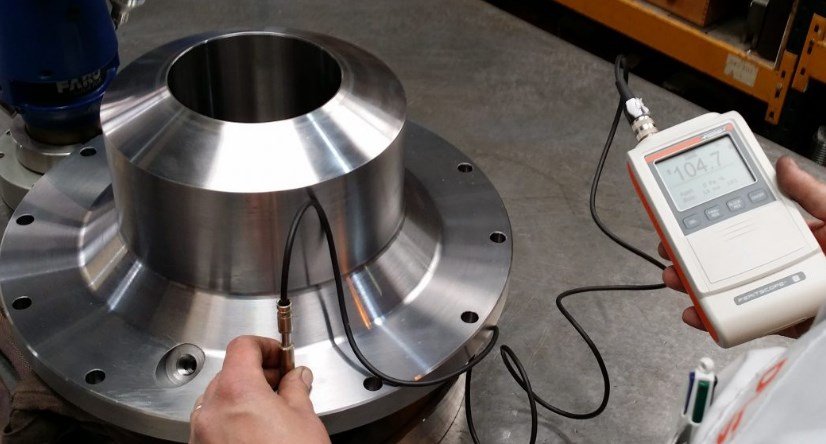
Surgical instruments, food processing screws, and pharmaceutical manufacturing equipment use 17-4 PH for its ability to withstand repeated sterilization cycles without degrading. Certification to relevant standards is required for medical and food-contact applications.
Heat Treatment of DS-4 Stainless Steel: A Practical Guide
Heat treatment is what makes 17-4 PH useful. Without it, the material has moderate strength. With the right aging cycle, it becomes one of the strongest stainless grades available. The process is straightforward but demands precision.
The cycle has two stages. First, solution annealing at about 1,038°C (1,900°F) for 30 minutes, followed by rapid cooling to room temperature. This puts the alloying elements into solution and creates a soft, machinable martensitic structure (Condition A).
Second, aging at a selected temperature between 480°C and 620°C for 1 to 4 hours. During this step, copper-rich precipitates form within the matrix. The aging temperature determines the final mechanical properties.
Lower aging temperatures (480°C / H900) produce the highest strength but reduce toughness. Higher aging temperatures (620°C / H1150) sacrifice some strength for better ductility and corrosion resistance. There is no single "right" condition — the choice depends on the application requirements.
For injection mold components made from 17 4 stainless steel, H1150 is the recommended starting point. It provides sufficient hardness for wear resistance while maintaining enough toughness to handle impact loads during mold operation. If the component experiences abrasive wear from glass-filled materials, consider moving to H1075 or H1025 for increased surface hardness.
Machining DS-4 Stainless Steel Material
Machining 17-4 PH is easiest in the solution-annealed condition (Condition A). The material has a machinability rating of about 75% compared to standard B1112 alloy steel. In the hardened condition, machinability drops, and tool wear increases.
Tips for machining 17-4 PH in mold and tooling applications:
Use carbide tooling for consistent edge retention. Run at moderate speeds with constant feed rates — interrupted cuts can cause work hardening. Apply generous coolant to manage heat buildup at the cutting edge. Avoid dwell or rubbing passes that create localized hardening.
For wire EDM operations, 17-4 PH cuts cleanly in both annealed and hardened conditions. The material's electrical conductivity of 2.3% IACS is typical for stainless grades and does not present special challenges for EDM equipment.
Welding DS-4 Stainless Steel
17-4 PH has good weldability. Fusion welding using TIG or MIG processes with 17-4 PH filler metal works well. Inert gas shielding is necessary to maintain the corrosion resistance of the weld zone. Pre-heating is not required, and post-weld annealing is optional depending on the application.
The important thing: after welding, the heat-affected zone is in an annealed, softened state. If the welded component needs full mechanical properties, it must be re-solution treated and re-aged. For non-critical applications, welding in the overaged condition (H1150) minimizes property loss in the HAZ.
Corrosion Resistance of DS-4 Stainless Steel
In the H1150 condition, 17-4 PH offers corrosion resistance comparable to 304 stainless steel. It performs well in atmospheric exposure, fresh water, steam, and mild chemical environments. The PREN (Pitting Resistance Equivalent Number) of 16 confirms moderate pitting resistance.
Limitations exist. 17-4 PH is not suitable for continuous immersion in seawater or exposure to strong reducing acids like hydrochloric or sulfuric acid. In these environments, 316 or duplex stainless grades are better choices. Stress corrosion cracking can also occur in H900-condition material under tensile load in chloride environments — another reason H1150 is preferred for general service. For comparative corrosion data across stainless grades, refer to AZoM's stainless steel properties guide and the MakeItFrom 17-4 PH technical data sheet.
Key Trends in DS-4 Stainless Steel Usage
Demand for 17-4 PH continues to grow across several sectors. In injection molding, the shift toward higher-cavitation molds and faster cycle times drives the need for stronger, more durable mold components that resist galling and wear without frequent replacement.
Additive manufacturing is opening new possibilities for 17-4 PH. The material is available as powder for selective laser melting (SLM) and binder jetting processes. Components with complex internal cooling channels — previously impossible to machine — can now be produced in 17-4 PH. This is particularly relevant for hot runner system components where conformal cooling improves temperature uniformity.
Sustainability considerations are also emerging. The embodied carbon of 17-4 PH is about 2.7 kg CO₂ per kg of material. While higher than carbon steel, the longer service life and elimination of coating processes can reduce the overall environmental footprint of a component over its lifecycle.
Frequently Asked Questions
What does 17-4 PH mean?
17 refers to approximately 17% chromium. 4 refers to approximately 4% nickel. PH stands for precipitation hardening — the heat treatment that gives the material its high strength.
Is 17-4 PH stainless steel magnetic?
Yes. 17-4 PH has a martensitic microstructure and is magnetic in all hardened conditions.
What condition of 17-4 PH is best for general use?
H1150 (aged at 620°C) is the most commonly specified condition. It offers the best balance of strength, toughness, corrosion resistance, and machinability.
Can 17-4 PH be welded?
Yes. Standard fusion welding processes work well. Post-weld heat treatment is recommended to restore full mechanical properties in the heat-affected zone.
How does 17-4 PH compare to 304 stainless steel?
17-4 PH is significantly stronger (about double the yield strength of 304) but slightly less corrosion-resistant. 304 is better for purely corrosive environments, while 17-4 PH is better for structural or load-bearing applications.
What is the maximum operating temperature for 17-4 PH?
For corrosion resistance, the maximum is about 450°C. For short-term mechanical loading, the material can withstand up to 850°C.
Is 17-4 PH suitable for food contact applications?
Yes, with appropriate certification. The material is used in food processing equipment where high strength and corrosion resistance are needed.
What is the difference between H900 and H1150?
H900 provides maximum strength (1,310 MPa tensile, 48 HRC) but lower toughness. H1150 provides balanced properties (1,000 MPa, 36 HRC) with better ductility and corrosion resistance.
Does 17-4 PH require post-machining heat treatment?
If the material is ordered in Condition A, parts can be machined first and then aged. This is the standard workflow for most molded components and tooling parts.
How do I specify 17-4 PH when ordering?
Always specify both the material designation and the heat treatment condition. Example: "17-4 PH stainless steel to ASTM A564 Type 630, Condition H1150."
Summary
17-4 PH stainless steel is a precipitation-hardening grade that delivers high strength and good corrosion resistance in a single alloy. Its properties are adjustable through heat treatment, making it suitable for a wide range of applications from injection mold tooling to aerospace components.
The key factors to remember: specify the condition when ordering, machine in Condition A when possible, and choose H1150 for the best all-around performance. For mold making, hot runner system components, and precision tooling, 17-4 PH provides a practical balance of strength, corrosion resistance, and cost that fewer alternatives can match.